Contact Form

banner

View our Privacy Policy to see how we keep your information safe.

Value Creation is in our DNA.

Value creation is central to the work we do to build
better businesses. We work closely with management teams to shape and deliver a plan that will maximise value for all stakeholders.

We‘ve pooled together our collective experience to identify what really drives value in businesses, and how to deliver it. That’s why, no matter what sector you’re in, working with NorthEdge will accelerate your value growth.

The NorthEdge community.

Portfolio Forums

At NorthEdge, we are committed to promoting a culture of community,
learning and collaboration.

Our portfolio forums provide unique access for business leaders, across many
different functions, to share best practice, generate ideas and learn from
experts in our network. Centered on our Value Levers, we invite speakers and
operating partners to present at each forum, offering valuable insights and
knowledge, and inspiring teams to take action in their own businesses.

Our portfolio is the Nexus of NorthEdge, which is why we have created a secure online community platform exclusively for NorthEdge portfolio company employees.

Whilst all of our portfolio businesses are unique, in our experience the challenges of growing a business are very similar.

Nexus allows members of our portfolio companies to connect real-time with their peers, access our operating partner network – trusted and recommended suppliers, and keep up to date with the latest NorthEdge news and insight from our network, centred around each of our Value Levers.

Creating a digital community allows us to stay connected, whatever happens (even a global pandemic), however we will also use the platform to support cross-portfolio collaboration at our events and forums.

Connecting over

140

users across the portfolio

Covering

8

functional areas

Access to

50

trusted operating partners

Sharing insights

from across our network

Our Value levers.

Vision.

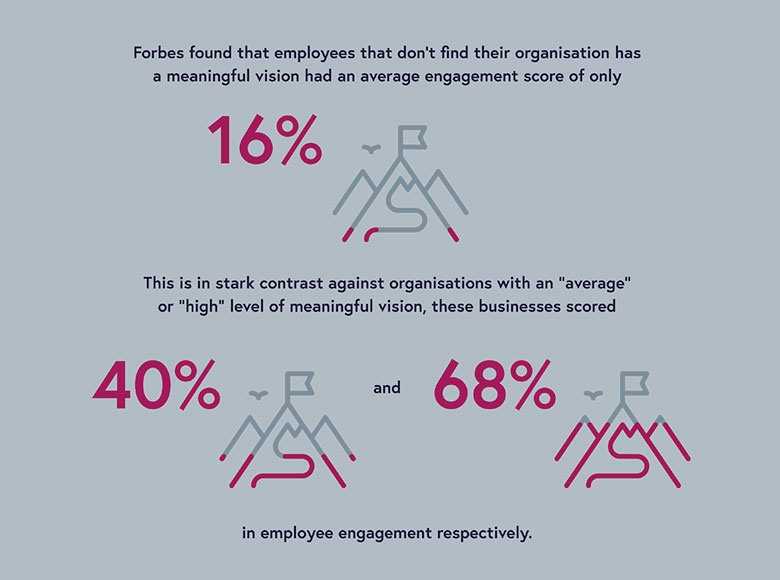
To successfully grow a business, it’s vital to maintain a clear and coherent strategic vision. An ambitious idea of where an organisation is going and what it stands for are key factors in future success in everything from employee attraction and retention to customer success and the bottom line.

Shared vision has a measurable impact on a wide range of performance measures according to the Massachusetts Institute of Technology. The Institute found that investment returns from 18 “visionary” companies were six times higher than their peers that did not manage with a vision.

However, research by Rungway of 2,000 employees in the UK has found that 52 per cent can’t communicate their organisation’s vision and 49 per cent cannot remember its values.
This suggests that some businesses are missing out on the benefits of having a clear and simple vision built into the fabric of their organisation.

While there is a growing appreciation for the importance of vision, with leaders like author Simon Sinek driving discussion on the issue, in order to ensure consistent and sustainable success it’s vital that businesses build on this. It must form a core part of the strategy – informing a robust and realistic plan that is effectively communicated to employees and embodied by action.

People.

Leadership, and its role in building the culture of an organisation, is a feature of successful growth.

A strong leadership culture helps to provide a clear purpose for the business and its people, as well as helping to build healthy and balanced working practices. These factors ultimately help create an environment where people are highly motivated and can thrive.
Management teams that demonstrate leadership capabilities and develop this skill across all levels of their workforce can see gains in resilience, agility and future-proofing. Leadership isn’t necessarily an innate talent, it’s something that teams can proactively and consistently develop.

Responsibility.

Responsibility can take on many different names and meanings. In the context of business, it refers to a company’s commitment to do more than just make a profit. It can involve businesses actively striving to contribute positively to the environment or even to social causes. Ultimately it defines how they conduct themselves responsibly. The name often associated with this commitment is Environmental, Social and Corporate Governance (ESG), which can be broken down into:

Although the case for a strong ESG proposition becomes more compelling when looking to combat issues such as climate change and the gender pay gap, it also makes sense from a commercial standpoint. A recent study from PWC found that 66% of respondents cited value creation as their main driver for ESG activity.

Responsibility is no longer considered a nice-to-have, it is now key in judging the value of businesses and will continue to be a core factor long into the future.

Technology.

Digital transformation can help enhance collaboration, provide a better customer experience and create efficiencies, all of which can create value.

Global spending on digital transformation is expected to top $2.3 trillion by 2023 according to IDC. However, research from McKinsey showed that 70 per cent of all digital transformation initiatives do not reach their goals. While businesses are clearly willing to invest, knowing how to avoid the pitfalls is crucial to success. Management teams need to think about culture, strategy, and customers at the outset of any project.

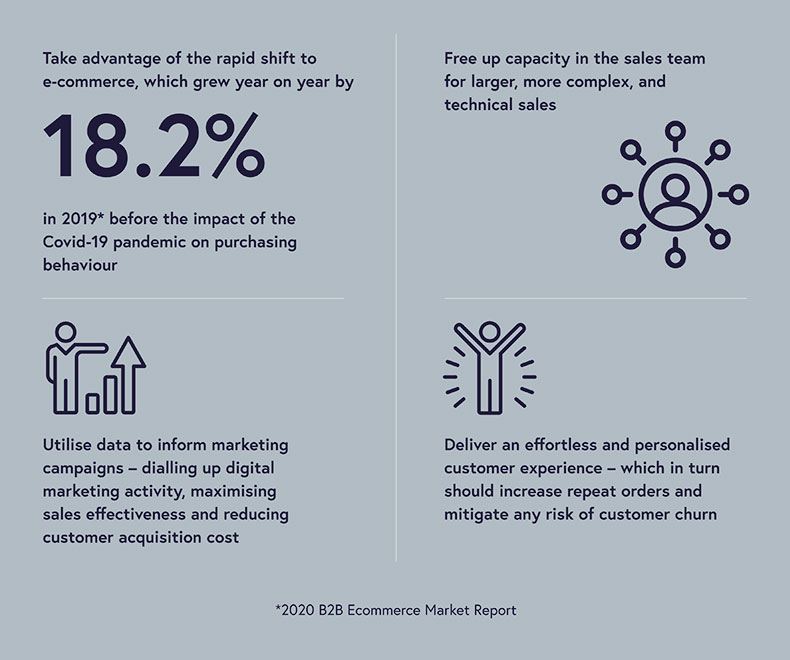
Take advantage of the rapid shift to e-commerce, which grew year on year by

18.2%

in 2019* before the impact of the Covid-19 pandemic on purchasing behaviour

Utilise data to inform marketing campaigns – dialling up digital marketing activity, maximising sales effectiveness and reducing customer acquisition cost

Free up capacity in the sales team for larger, more complex, and technical sales

Deliver an effortless and personalised customer experience – which in turn should increase repeat orders and mitigate any risk of customer churn

*2020 B2B Ecommerce Market Report

Customer Success.

From understanding customer data, demonstrating customer lifetime value and monitoring customer health we can support you to increase up sell and decrease churn

Operational effectiveness.

There’s often a misconception in business that operational effectiveness is being able to deliver a product or service at the lowest possible cost. And, as a result, companies typically only target cost efficiencies to improve margins.

But operational effectiveness is about so much more than just cost. Effectiveness is not driven by just improving margins and productivity, but also by equipping businesses for continued growth, scalability and agility – ensuring the organisation can pivot and adapt in challenging circumstances.

These are all factors that need to be considered. Not only in terms of cost effectiveness and margin enhancements, but to ensure they are robust, agile and future-proof – allowing businesses to scale up without risking customer experience.

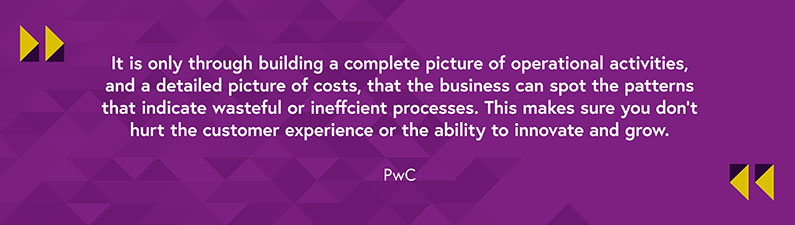
It is only through building a complete picture of operational activities, and a detailed picture of costs, that the business can spot the patterns that indicate wasteful or inefficient processes. This makes sure you don’t hurt the customer experience or the ability to innovate and grow

PwC

Commercial effectiveness.

The question many businesses first ask when seeking to expand is how do we increase sales volume? Whilst this is a valid starting point, commercial effectiveness means not just assessing how volumes can be increased, but how customer relationships can be deepened, how strategic revenue streams can be developed, and how pricing strategies can be implemented to create better returns.

Commercial effectiveness is a vital facet of a healthy business, not only does it help achieve top-line growth, it increases performance, predictability and improves the quality of earnings.

However it must not be limited to simply expanding sales and increasing volumes. Deepening customer relationships and developing strategic revenue streams and pricing strategies are also important elements of commercial effectiveness.

M&A.

We help you with all aspects of M&A, from mapping the landscape and sourcing opportunities through to buying and integrating

Internationalisation.

We work with you to help identify ways to grow your business even faster – supporting you to expand your geographical reach and strategically develop the business

Innovation.

We challenge and empower you to collaborate, debate and do things differently in your business to keep you at the top of your game.

Successful companies recognise that innovation is a competitive necessity to drive value and accelerate growth.

A PWC report tracked the three-year revenue growth of businesses who put innovation as their priority, against those that didn’t. The results showed that the most innovative group had grown their revenues at a rate 16% higher than the least innovative, which equated to almost $0.25bn of additional revenue.

Regardless of an organisation’s size, there is no doubt that innovation has become a fundamental element of business success. The challenge for management teams is how to create, embrace and foster a culture of innovation, to keep their business at the top of their game.